
| “Dedicated to everyone who believes in peace, love, and non-violence, let’s keep the torch burning.” inscription on the plaque of the statue of Medgar Evers at The Jackson Library. |

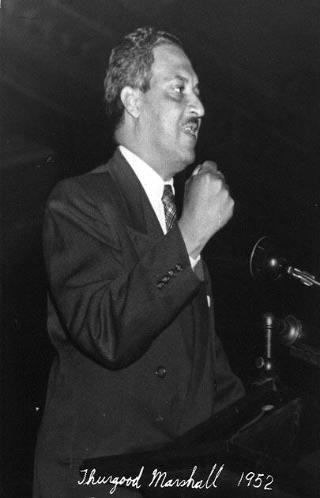
Thurgood Marshall & the Courts
Bobby Kennedy was not the first or only
person that Charles Evers liked for the
job that they were doing and who hoped
they would stay. There was longtime
friend, Thurgood Marshall, as NAACP Legal
Defense Fund Director, who argued the
landmark Brown v. Board of Education case
which barred “separate but equal
schools” Both Evers had aspirations of
being lawyers in his mode.
“Thurgood and I were friends. He said
‘they’ve offered me an appointment to the
U.S. Supreme Court. I said ‘Hell No,
once they hire you they control you, keep
doing what you’re doing here . He said
“I can do good things over there; we need
a black on the Supreme Court. I’d like
your support. I told him, ‘Thurgood I
would never come out against you, go
ahead but I hate to see you go but we’ll
find somebody else’.”
And although our meeting with Evers took
place before the just announced Supreme
Court decision***** which struck down two
voluntary school integration programs and
which justices on both sides invoked
Brown v. Board, Evers did offer his
thoughts about the recent 53rd
anniversary of the Brown case:
“The first thing we said is are they
going to enforce it? Are we going to be
able to really do it. When we started
trying integration that’s when we really
proved that it was worth it because we
have Blacks in every school, every
university, black coaches at Ole Miss,
Mississippi State…white kids who are
cheering for us now are relatives of
older whites who hated us and that’s one
heck of a step forward for all of us….
“There be should appreciation for those
who made it possible for us now to be
able to enjoy and take advantage of its
benefits…It’s something we should always
remember where we came from.”
A Supreme Court case that he was
specifically involved with in 1966 was
NAACP v. Claiborne. Charles Evers was
sued along with The NAACP, The
Mississippi Action for Progress, and
Aaron Henry, President of The Mississippi
State Conference of the NAACP by 17 white
merchants. The case resulted from a
boycott of stores that Evers had
organized as Field Director of the
Mississippi branch of the NAACP. A
petition which had been approved by the
NAACP for 19 specific demands was
presented to public officials and
Claiborne County calling for “the
desegration of all public schools, and
public facilities, the hiring of Black
policemen, public improvements in Black
residential areas, selection of Blacks
for jury duty, integration of bus
stations, so that Blacks could use all
facilities, and all stores must employ
Negro clerks and cashiers and an end to
verbal abuse by law enforcement
officers.”
The petition stated that Negroes were not
to be addressed by derogatory terms. A
favorable response was not received. In
addition, “a young Black man named
Roosevelt Jackson was shot and killed
during an encounter with two Port Gibson
police officers.” (as cited in the
Supreme Court opinion 458 US 886) Large
crowds gathered at the hospital and a
curfew was placed in effect.
Evers made two speeches to crowds and is
reported to have told his audience that
Bobby Kennedy was not the first or only
person that Charles Evers liked for the
job that they were doing and who hoped
they would stay. There was longtime
friend, Thurgood Marshall, as NAACP Legal
Defense Fund Director, who argued the
landmark Brown v. Board of Education case
which barred “separate but equal
schools” Both Evers had aspirations of
being lawyers in his mode.
“Thurgood and I were friends. He said
‘they’ve offered me an appointment to the
U.S. Supreme Court. I said ‘Hell No,
once they hire you they control you, keep
doing what you’re doing here . He said
“I can do good things over there; we need
a black on the Supreme Court. I’d like
your support. I told him, ‘Thurgood I
would never come out against you, go
ahead but I hate to see you go but we’ll
find somebody else’.”
And although our meeting with Evers took
place before the just announced Supreme
Court decision***** which struck down two
voluntary school integration programs and
which justices on both sides invoked
Brown v. Board, Evers did offer his
thoughts about the recent 53rd
anniversary of the Brown case:
“The first thing we said is are they
going to enforce it? Are we going to be
able to really do it. When we started
trying integration that’s when we really
proved that it was worth it because we
have Blacks in every school, every
university, black coaches at Ole Miss,
Mississippi State…white kids who are
cheering for us now are relatives of
older whites who hated us and that’s one
heck of a step forward for all of us….
“There be should appreciation for those
who made it possible for us now to be
able to enjoy and take advantage of its
benefits…It’s something we should always
remember where we came from.”
A Supreme Court case that he was
specifically involved with in 1966 was
NAACP v. Claiborne. Charles Evers was
sued along with The NAACP, The
Mississippi Action for Progress, and
Aaron Henry, President of The Mississippi
State Conference of the NAACP by 17 white
merchants. The case resulted from a
boycott of stores that Evers had
organized as Field Director of the
Mississippi branch of the NAACP. A
petition which had been approved by the
NAACP for 19 specific demands was
presented to public officials and
Claiborne County calling for “the
desegration of all public schools, and
public facilities, the hiring of Black
policemen, public improvements in Black
residential areas, selection of Blacks
for jury duty, integration of bus
stations, so that Blacks could use all
facilities, and all stores must employ
Negro clerks and cashiers and an end to
verbal abuse by law enforcement
officers.”
The petition stated that Negroes were not
to be addressed by derogatory terms. A
favorable response was not received. In
addition, “a young Black man named
Roosevelt Jackson was shot and killed
during an encounter with two Port Gibson
police officers.” (as cited in the
Supreme Court opinion 458 US 886) Large
crowds gathered at the hospital and a
curfew was placed in effect.
Evers made two speeches to crowds and is
reported to have told his audience that
boycott violators would be “watched and
that blacks would be answerable to him
and that any ‘uncle toms’ who broke the
boycott would ‘have their necks broken’
by their own people. Evers remarks were
directed to all 8000 plus Black residents
of Claiborne County and not merely the
relatively few members of the Claiborne
County NAACP,” according to footnote 28
in the Supreme Court opinion.
In 1982, The Court ruled that the
judgment against Evers could not be
justified nor could liability, and his
speeches did not incite or specifically
authorize the use of violence.
“I didn’t call for violence but I called
to make sure that blacks understood,
don’t cross the line… We encouraged and
we enforced the boycott. We called them
Deacons of Defense. We were there to make
sure that blacks, Negroes at the time did
not go in and out of those boycotted
stores and we meant that! And if they
were in there we took care of them. One
time, we took all of their groceries and
gave them to a poor old lady who didn’t
have anything. And if necessary, we
would give them an ass whipping with a
belt strap, or give them a good shaking,
I remember we flattened an auto guy’s
tires who had gone into one of the stores
that we had boycotted. Occasionally, we’
d bust a few windows. There was an old
preacher who was bullheaded and we
knocked all of his windows out,” he
recalls.
Evers also successfully organized a
series of boycotts most notably in
Natchez following the car bombing of tire
worker and NAACP head of voter
registration there of George Metcalf --
and which according to author Taylor
Branch in ‘At Canaan’s Edge America in
the King Years’ resulted in an “agreement
calling for a bi-racial commission, the
opening of some city jobs to Negroes,
integration of public facilities
including the library and hospital, and
the required use of courtesy titles by
city officials and signatory merchants
alike, specifically banning the
diminutives, “boy, “uncle,” “auntie,”
“hoss” or any other offensive name.”
Additional successful boycotts included
in Fayette, Jackson, and Woodville,
Mississippi.
that blacks would be answerable to him
and that any ‘uncle toms’ who broke the
boycott would ‘have their necks broken’
by their own people. Evers remarks were
directed to all 8000 plus Black residents
of Claiborne County and not merely the
relatively few members of the Claiborne
County NAACP,” according to footnote 28
in the Supreme Court opinion.
In 1982, The Court ruled that the
judgment against Evers could not be
justified nor could liability, and his
speeches did not incite or specifically
authorize the use of violence.
“I didn’t call for violence but I called
to make sure that blacks understood,
don’t cross the line… We encouraged and
we enforced the boycott. We called them
Deacons of Defense. We were there to make
sure that blacks, Negroes at the time did
not go in and out of those boycotted
stores and we meant that! And if they
were in there we took care of them. One
time, we took all of their groceries and
gave them to a poor old lady who didn’t
have anything. And if necessary, we
would give them an ass whipping with a
belt strap, or give them a good shaking,
I remember we flattened an auto guy’s
tires who had gone into one of the stores
that we had boycotted. Occasionally, we’
d bust a few windows. There was an old
preacher who was bullheaded and we
knocked all of his windows out,” he
recalls.
Evers also successfully organized a
series of boycotts most notably in
Natchez following the car bombing of tire
worker and NAACP head of voter
registration there of George Metcalf --
and which according to author Taylor
Branch in ‘At Canaan’s Edge America in
the King Years’ resulted in an “agreement
calling for a bi-racial commission, the
opening of some city jobs to Negroes,
integration of public facilities
including the library and hospital, and
the required use of courtesy titles by
city officials and signatory merchants
alike, specifically banning the
diminutives, “boy, “uncle,” “auntie,”
“hoss” or any other offensive name.”
Additional successful boycotts included
in Fayette, Jackson, and Woodville,
Mississippi.
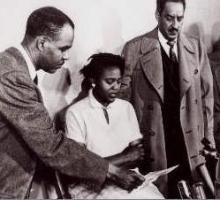
| Marshall with plaintiffs in Brown v Board of Education |
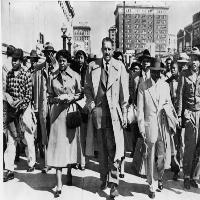
| Marshall with client Autherine Lucy, the first African American student to be admitted to the University of Alabama in 1956 |


| Medgar, the Movement & More an interview with Charles Evers - by David Koppel |
| Thurgood Marshall & the Courts |






| by David Koppel © 2007 |