
| “Dedicated to everyone who believes in peace, love, and non-violence, let’s keep the torch burning.” inscription on the plaque of the statue of Medgar Evers at The Jackson Library. |

ROBERT KENNEDY
In 1963, Charles was consoled by Robert
Kennedy at the service before the burial
and then at Arlington National Cemetery
when Medgar was buried. They became even
closer when JFK was killed. They had
first met in 1960 during JFK’s
Presidential campaign.
“He was my dearest friend and Bobby
wanted to learn. Bobby was a millionaire
brat who didn’t know about the poverty
and suffering, he had never seen it and
he wanted to learn about it. When Evers
showed him the Delta’s poorest sections
it had a profound effect on RFK.
Evers also enlightened him about
segregation. I said ‘Bobby, you know if
you and I were in Mississippi we couldn’t
go to the same hotel. He started to say
‘Oh no, and I said I couldn’t go there
with you.
“You couldn’t stay at my house either.
They’d burn my damn house down. He didn’
t believe that. I finally kept telling
him and he finally began to realize that
what I was saying was true.”
Evers liked Kennedy’s work first as
Attorney General particularly in his
dealing with the integration of James
Meredith at Ole Miss, and later as a
Senator. He didn’t want to him to run
for President. Evers was a volunteer for
Kennedy’s campaign and his support was
sought by RFK.
In 1963, Charles was consoled by Robert
Kennedy at the service before the burial
and then at Arlington National Cemetery
when Medgar was buried. They became even
closer when JFK was killed. They had
first met in 1960 during JFK’s
Presidential campaign.
“He was my dearest friend and Bobby
wanted to learn. Bobby was a millionaire
brat who didn’t know about the poverty
and suffering, he had never seen it and
he wanted to learn about it. When Evers
showed him the Delta’s poorest sections
it had a profound effect on RFK.
Evers also enlightened him about
segregation. I said ‘Bobby, you know if
you and I were in Mississippi we couldn’t
go to the same hotel. He started to say
‘Oh no, and I said I couldn’t go there
with you.
“You couldn’t stay at my house either.
They’d burn my damn house down. He didn’
t believe that. I finally kept telling
him and he finally began to realize that
what I was saying was true.”
Evers liked Kennedy’s work first as
Attorney General particularly in his
dealing with the integration of James
Meredith at Ole Miss, and later as a
Senator. He didn’t want to him to run
for President. Evers was a volunteer for
Kennedy’s campaign and his support was
sought by RFK.
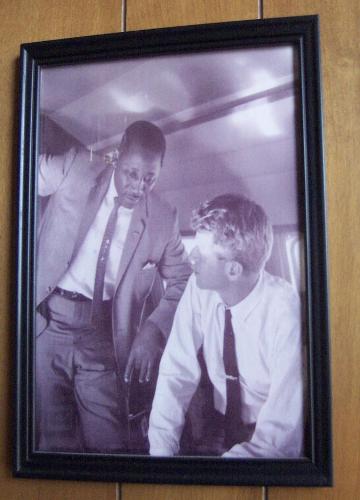
| photo of Charles Evers and Robert Kennedy |
“He flew me up to Washington and told me I’m
going to run for President‘I said Oh Bobby,
please!’ and ‘he said I need to run, would you
be with me?” ‘I said if you run, I’m there
but I wish you wouldn’t.’ I didn’t want him
to run because of what happened to John.”
Evers campaigned for RFK and was also with him
the night of his assassination in 1968.
going to run for President‘I said Oh Bobby,
please!’ and ‘he said I need to run, would you
be with me?” ‘I said if you run, I’m there
but I wish you wouldn’t.’ I didn’t want him
to run because of what happened to John.”
Evers campaigned for RFK and was also with him
the night of his assassination in 1968.


| Medgar, the Movement & More an interview with Charles Evers - by David Koppel |

Robert Kennedy









| by David Koppel © 2007 |